
In many transactions, due diligence continues to be equated with legal due diligence. In modern M&A practice, however, legal review represents only one component within a multi-layered analytical framework designed to assess risk, value, and overall deal viability.
At HTH and Partners, due diligence is not approached as a checklist exercise. It is a structured decision-making tool that informs investment strategy and shapes transaction architecture.
Mục lục bài viết
1. Legal Due Diligence. Establishing the Transaction Risk Baseline
Legal due diligence constitutes the foundational layer of most M&A processes. Its scope typically includes corporate structure, ownership and capitalisation, material contracts and key commercial arrangements, litigation and regulatory exposure, compliance with applicable laws and licensing requirements, and employment-related obligations.
However, the true value of legal due diligence lies not in identifying technical legal issues, but in assessing their impact on the transaction.
From an advisory perspective, key considerations include whether identified issues may constitute deal blockers, whether third-party consents or regulatory approvals are required prior to completion, whether change-of-control provisions may be triggered, and the likelihood and magnitude of contingent liabilities.
Importantly, legal due diligence findings must be translated into transaction documentation, including representations and warranties, conditions precedent, indemnity provisions, and tailored risk allocation mechanisms. Absent such translation, legal due diligence risks remaining descriptive rather than actionable.
2. Financial Due Diligence. Testing Economic Reality
Financial due diligence extends beyond the review of financial statements. Its primary objective is to assess the quality and sustainability of financial performance.
Key areas of analysis include earnings quality and adjustments, cash flow generation and sustainability, off-balance sheet or contingent liabilities, and working capital dynamics.
The outcome of financial due diligence has a direct impact on valuation, pricing mechanisms, and payment structuring within the transaction.
3. Commercial Due Diligence. Validating the Investment Thesis
Commercial due diligence represents the most strategic layer of analysis. It is directed toward assessing the validity of the underlying investment rationale.
The central question is not merely whether the target is compliant, but whether the business is fundamentally worth acquiring.
This analysis encompasses market positioning, competitive dynamics, customer concentration risks, growth potential, and the robustness of key business assumptions.
Commercial due diligence findings often play a decisive role in determining whether a transaction proceeds, is restructured, or is abandoned.
4. Operational Due Diligence. Assessing Execution Capability and Integration Risk
Operational due diligence focuses on the target’s operational effectiveness and its readiness for post-transaction integration.
Core areas include internal systems and processes, management capability, key personnel dependencies, operational efficiency, and potential integration risks.
This layer is critical to the success of post-merger integration and long-term value realization.
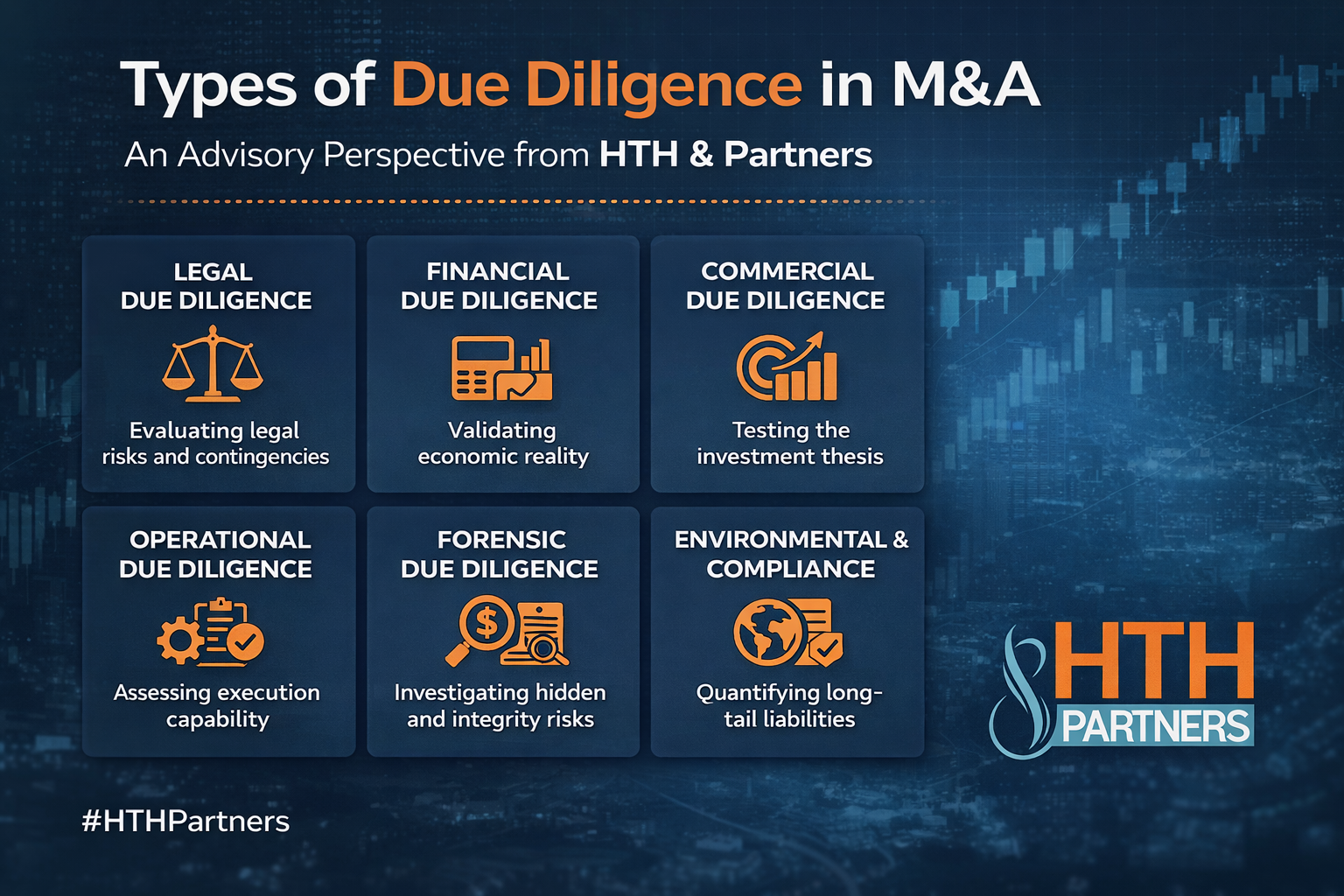
Types of Due Diligence in M&A. A Strategic Perspective
5. Forensic Due Diligence. Identifying Hidden Risks
Where red flags or anomalies arise, forensic due diligence is undertaken to investigate risks that may not be detectable through standard review processes.
This may include fraud, misconduct, irregular transactions, conflicts of interest, and governance failures.
Findings at this stage are often high-impact and may significantly alter the structure of the transaction or the decision to proceed.
6. Environmental and Compliance Due Diligence. Long-Term Risk Exposure
Environmental and regulatory compliance risks are frequently underestimated, yet they may give rise to substantial long-term liabilities.
The scope typically includes environmental compliance, remediation obligations, associated costs, and broader ESG-related considerations.
These risks are often cumulative in nature and may materially affect long-term investment value.
7. Strategic Insight
There is no universal due diligence model applicable to all transactions.
An effective due diligence process requires a focus on material risks, alignment of scope with transaction objectives, and the translation of findings into concrete legal and commercial mechanisms.
8. Conclusion
Due diligence is not a process aimed at identifying every issue within a target company.
It is a process designed to identify issues that are material to the transaction, to assess their impact, and to translate them into negotiation leverage and transaction structuring.
Accordingly, the true value of due diligence lies not in the volume of information reviewed, but in the ability to identify and understand the factors that are determinative to the success of the transaction.
Disclaimer:
This article is intended for informational purposes only and does not constitute legal advice from HTH & Partners. The content represents the views of HTH & Partners and is subject to change without prior notice.
The legal provisions referenced in this article were valid at the time of publication but may have been amended or repealed by the time of reading. We strongly recommend consulting a qualified legal professional before applying any information contained herein.