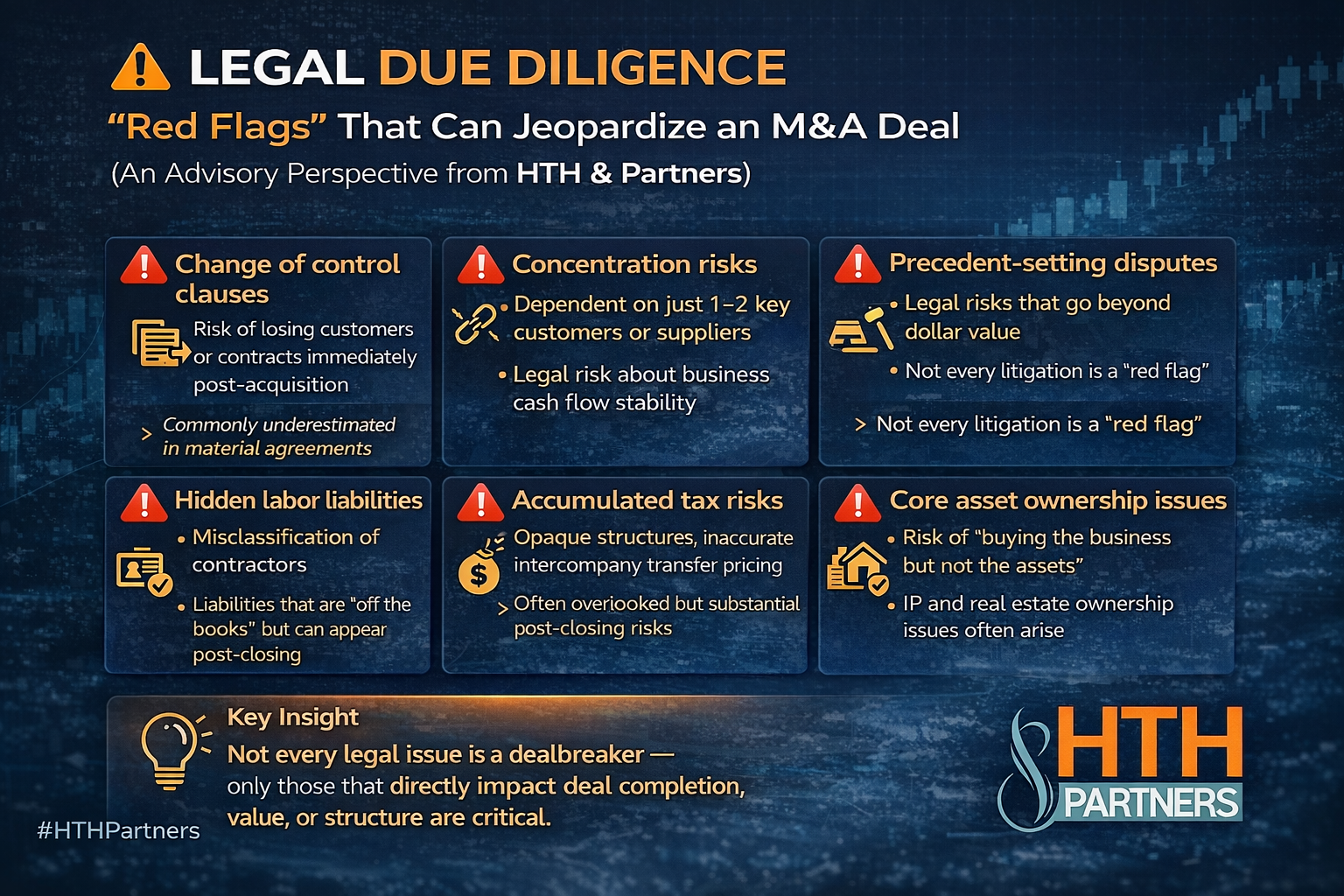
In practice, due diligence is often perceived as a technical exercise involving document review, contract examination, and checklist verification. However, such a view does not adequately reflect its role within the context of mergers and acquisitions transactions.
From a legal advisory perspective, due diligence should be understood as a structured analytical process that directly supports investment decision-making and transaction structuring.
Mục lục bài viết
1. Legal Nature and Function of Due Diligence
At its core, due diligence is a process of gathering, verifying, and evaluating information to identify factors that may affect the value, legality, and enforceability of a transaction.
Through this process, the acquirer is able to:
- Obtain an accurate understanding of the target’s legal structure and operational model
- Identify existing and contingent liabilities
- Assess regulatory compliance and potential legal exposures
- Evaluate the alignment of the transaction with its investment strategy
Accordingly, due diligence is not limited to identifying issues, but extends to assessing the implications of such issues on the transaction as a whole.
-
Role of Due Diligence in Valuation and Deal Structuring
One of the principal functions of due diligence is to provide the foundation for pricing adjustments and contractual structuring.
First, from a valuation perspective, findings arising from due diligence may result in adjustments to the purchase price to reflect legal and financial risks. Transaction value therefore becomes a function of risk-adjusted assessment rather than nominal valuation.
Second, from a legal structuring perspective, identified risks are translated into contractual mechanisms, including:
- Representations and warranties provided by the seller
- Indemnities addressing identified liabilities
- Escrow or holdback arrangements to secure post-closing obligations
- Conditions precedent to be satisfied prior to completion
In this regard, due diligence serves as the basis for converting factual findings into enforceable legal rights and obligations between the parties.
-
Due Diligence as a Mechanism for Risk Allocation
In M&A transactions, risks are not eliminated but allocated between the parties through contractual arrangements. Due diligence plays a central role in identifying and defining the scope of such risks.
These risks may be addressed through various mechanisms:
- Reflected in the purchase price
- Allocated to the seller through representations, warranties, and indemnities
- Resolved prior to closing through conditions precedent
- Or retained by the buyer as residual risk where allocation is not feasible
The effectiveness of due diligence therefore lies not in the identification of risks alone, but in the ability to translate those risks into appropriate allocation mechanisms.

Due Diligence Is Not Merely Document Review but a Strategic Instrument in M&A Transactions
4. Limitations of a Formalistic Approach
A purely formalistic approach to due diligence, focused primarily on document collection and review, often leads to two principal shortcomings.
First, it may result in information overload without meaningful analysis, thereby obscuring material risks.
Second, it may fail to connect findings with transaction structuring, rendering the information ineffective in negotiations and contractual drafting.
This underscores that due diligence is not a compliance exercise, but a substantive analytical process.
5. Role of Legal Judgment and Experience
Although due diligence is conducted within a structured framework, its effectiveness depends significantly on the experience and professional judgment of the advisory team.
Key determinants include:
- The ability to identify material risks
- The ability to assess legal and commercial impact
- The ability to formulate targeted and diagnostic inquiries
- The ability to integrate findings into transaction structuring and negotiation strategy
Due diligence is therefore not purely technical, but requires a high degree of legal judgment and transactional insight.
Conclusion
Due diligence should not be viewed as a procedural step or a formal requirement in M&A transactions.
It is a core transactional tool that:
- Supports informed investment decisions
- Shapes transaction valuation
- Allocates legal risk between the parties
- And underpins the legal structure of the transaction
Accordingly, approaching due diligence as a strategic instrument, rather than a procedural obligation, is critical to the successful execution of any M&A transaction.
Disclaimer:
This article is intended for informational purposes only and does not constitute legal advice from HTH & Partners. The content represents the views of HTH & Partners and is subject to change without prior notice.
The legal provisions referenced in this article were valid at the time of publication but may have been amended or repealed by the time of reading. We strongly recommend consulting a qualified legal professional before applying any information contained herein.